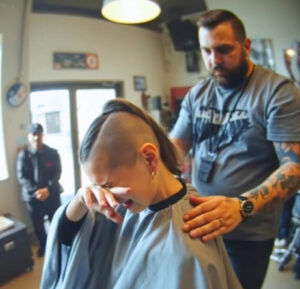
The young woman sat silently in the barber’s chair, her fingers tightly intertwined in her lap until her knuckles turned pale from the pressure.
The steady buzz of clippers somewhere behind her filled the room, a mechanical sound that seemed to mirror the frantic pace of her heartbeat. No matter how evenly she tried to breathe, the tension inside her refused to loosen.
She smoothed her palms over her thighs, inhaling slowly, exhaling carefully, hoping to calm the turmoil rising in her chest. But the feeling lingered — the unsettling realization that the body she once trusted no longer felt familiar, that something fundamental was slipping away from her control.
Her hand drifted upward almost without thought, brushing over the strands of hair that had once fallen thick and full around her face. Now, they slid through her fingers too easily, falling away and drifting down toward the floor.
Each strand felt like proof of the quiet battle she had been fighting alone for months.
At home, she had stood countless times in front of the bathroom mirror, staring in disbelief at the pillow each morning, at the clumps gathering in the shower drain. She remembered the panic tightening her throat — that helpless fear that comes when your body seems to turn against you, while the rest of the world carries on as if nothing has changed.
No one noticed. Not friends. Not coworkers. Not even the people who spoke to her every day.
Her eyes burned as she finally lifted her gaze to the mirror. The reflection staring back at her looked fragile — thinning hair framing a face caught between fear, acceptance, and quiet grief.
She didn’t wipe the tears as they slipped down her cheeks. This moment demanded honesty. It demanded to be felt.
With every pass of the clippers, her chest tightened, each fallen lock feeling like another piece of her confidence, her identity, being taken away.
The lump in her throat refused to disappear, leaving her shaking, voiceless, surrounded by the constant hum of the shop.
Life went on around her. Conversations murmured softly. Someone laughed. Scissors snipped in the distance.
But for her, time collapsed inward, shrinking until only the chair, the mirror, and her own vulnerability existed.
Then, unexpectedly, everything changed.
A warm hand rested gently on her shoulder.
She startled, flinching at the sudden contact, unprepared for human closeness breaking through her private despair.
When she looked up, she saw Jake standing beside her — broad-shouldered, calm, with a presence that felt solid and grounding. His face carried the quiet marks of experience, and when his eyes met hers, there was no pity there. No judgment.
Only understanding.
Without speaking, he reached up and removed his cap. Thick, dark hair spilled free. Slowly, deliberately, he picked up the clippers, their metal catching the bright light of the shop.
He took a steady breath, switched them on — and began shaving his own head.
Her breath caught. Words failed her.
She watched, stunned, as his hair fell in heavy clumps to the floor. The room seemed to hold its breath, the usual noise fading until only the buzz of clippers and the weight of the moment remained.
The other barbers froze at first, exchanging confused looks. But something about Jake’s quiet resolve shifted the air.
One by one, they followed.
Clippers roared to life across the room. Heads bowed. Hair fell.
What began as a simple haircut transformed into something far greater — an unspoken act of unity.
This wasn’t about appearance or bravado. It wasn’t about style.
It was about presence. About recognition. About stepping into someone else’s pain and saying, we see you.
The woman sat motionless, tears flowing freely now as hair gathered across the floor — hers and theirs alike.
Every buzz seemed to whisper reassurance: You’re not alone.
Emotion surged through her — grief and relief, fear and strength, all tangled together. She had come expecting shame, isolation, quiet suffering.
Instead, she found connection.
Her tears changed. These were no longer tears of loss, but of gratitude — of release.
Her shoulders slowly relaxed, tension draining from her body for the first time in months. Warmth spread through her chest, grounding her in a truth she hadn’t known she needed: her pain was seen.
Jake caught her eye and offered a small, knowing smile.
“We’ve got you,” he said softly.
She let out a shaky laugh, fragile but freeing.
When she looked around, the mirrors reflected something remarkable — not bald heads, but courage. Vulnerability. A bond formed without speeches or explanations.
Tentatively, she touched her own scalp. The smoothness surprised her. It was a reminder of loss — but also of bravery.
She didn’t pull her hand away.
Jake leaned closer. “Being brave doesn’t mean being alone,” he murmured.
The words settled deep within her.
Outside, cool air brushed against her bare head. She expected it to sting. Instead, it felt clean. New.
She walked away lighter than she had arrived — her steps steady, her heart fuller.
What began as a moment of fear became a turning point.
She understood now that while loss could take physical things — hair, certainty, control — it could never erase humanity’s capacity for empathy.
That barbershop became more than a place of routine. It became a sanctuary — where pain was met with kindness, and courage was shared.
She entered weighed down by fear and left carrying strength.
And she knew, without doubt, that the deepest power doesn’t come from hiding vulnerability — but from sharing it.