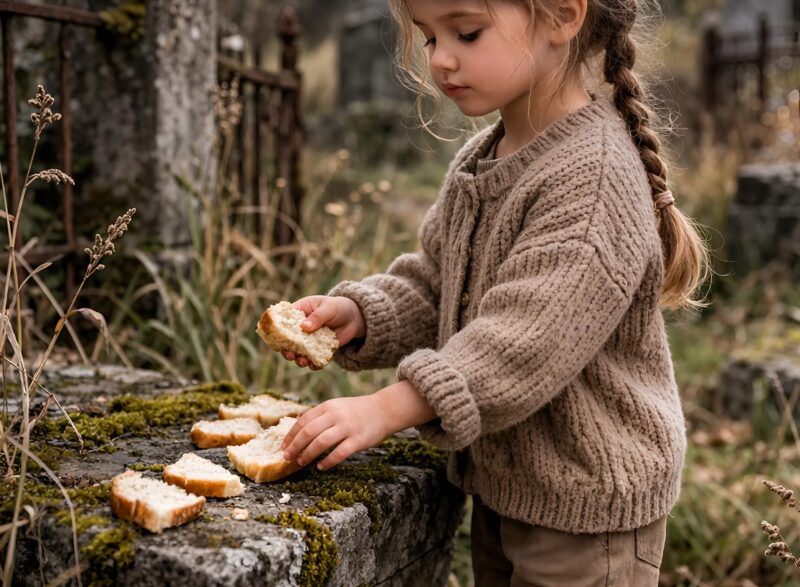
A six-year-old girl placed bread on the same grave nearly every week for a year. Her mother assumed she was just feeding the birds — but when she discovered the real reason, she was deeply shaken 😨😢
When Anna lost her husband a year ago, it felt as though time had frozen. The house grew painfully quiet, far too large for just the two of them. Her five-year-old daughter kept asking when Daddy would return, and each time Anna struggled to answer. As months passed, a heavy new routine took shape — every Sunday, they visited the cemetery.
They would leave early. Anna carried a modest bouquet of flowers, while her daughter walked beside her, hand in hand. The route was always the same: a quiet street, an alley lined with tall poplars, and finally the old iron gates of the cemetery. The girl rarely spoke, staring at the ground and squeezing her mother’s hand tightly.
After a while, Anna began noticing something unusual. Before each visit, her daughter would take a few slices of bread from the table. If there wasn’t any, she insisted they buy some. At first, Anna thought nothing of it — she assumed her daughter wanted to feed the birds.
Yet she had never actually seen pigeons or sparrows there. Instead, the girl would walk not only to her father’s grave, but also to an old neighboring one with a weathered stone and a faded photograph. Carefully, almost ceremoniously, she placed pieces of bread on the headstone, arranging them as if setting a small table. Then she would step back quietly.
This went on for nearly a year.
One Sunday, Anna finally asked as her daughter laid down the bread once more.

“Sweetheart, are you leaving that for the birds?”
“No,” the girl answered calmly.
“Then who is it for?”
The reply sent a chill through her mother 😱😢
The girl glanced at the photograph on the nearby grave and spoke simply:
“For Grandma. She was hungry that day.”
Anna felt her heart stop.
Her daughter explained that on the day of her father’s funeral, she had noticed a very old woman sitting on a bench, pale and softly asking passersby for a piece of bread. The woman said she hadn’t eaten all day.
No one paid attention. The girl had been holding a piece of bread her mother gave her as a snack. She walked over and offered it to the woman. The old lady accepted it, smiled gently, and thanked her.
“I never saw her again,” the child continued. “But later I saw her picture on this grave. So I thought maybe she was still hungry. That’s why I bring her bread. Maybe she doesn’t have anything to eat there.”
Anna felt a tight knot form in her chest. She remembered the funeral — the noise, the grief, the overwhelming blur of faces. She didn’t recall any elderly woman asking for food.
But the faded photograph on the neighboring grave did show an old woman. And the date of death matched the very same day as her husband’s.

Anna looked at her daughter, unsure of what to say. It wasn’t just the story that unsettled her — it was the quiet certainty in her child’s voice, as though what she described was perfectly natural.
From that Sunday on, Anna stopped questioning it. Each week they followed the same path. And her daughter continued gently placing pieces of bread on the weathered stone.