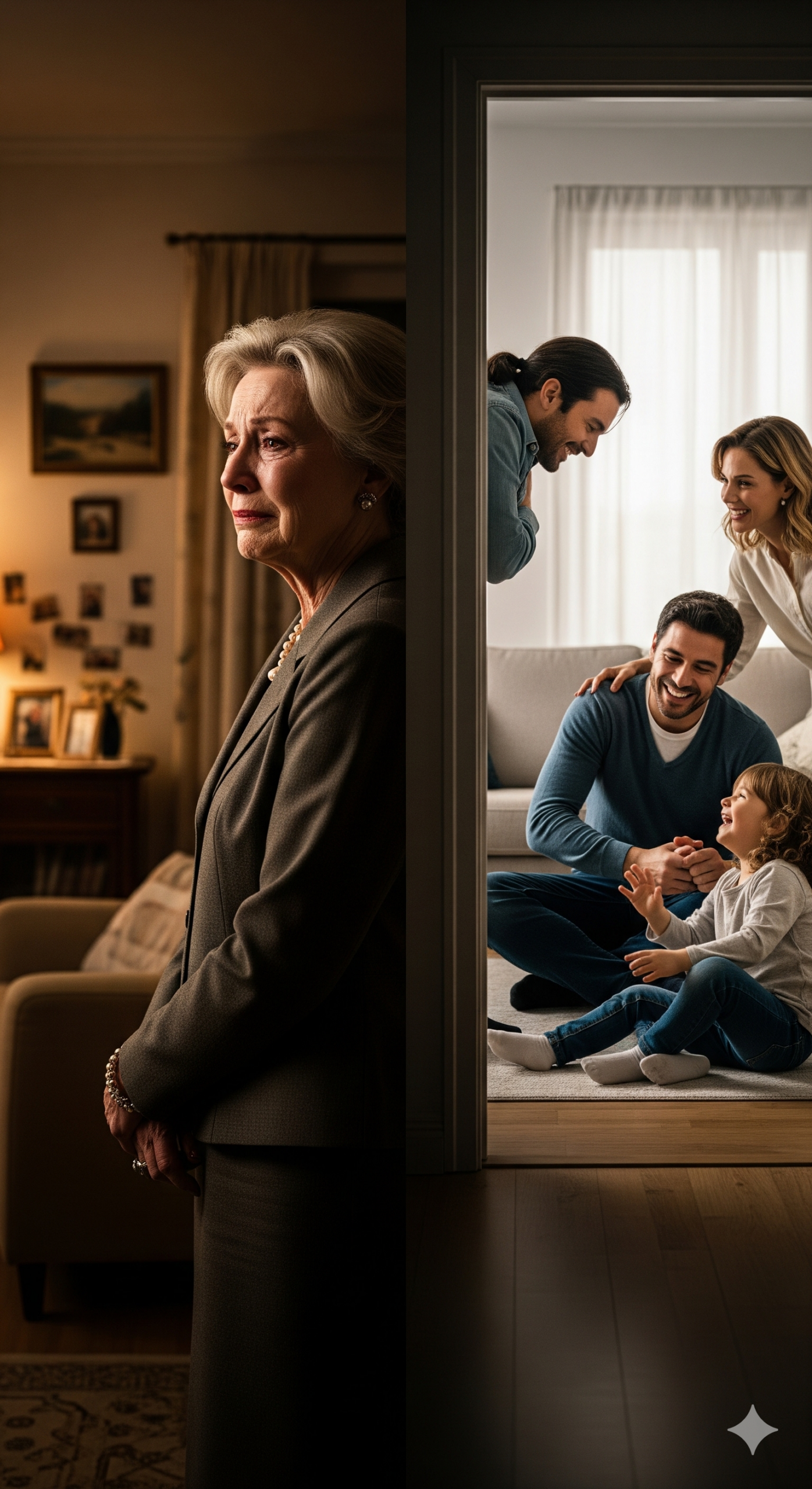
When Jonathan chose love over legacy, his mother cut him off without a second glance.
Three years later, she came back — no apology, just judgment in her eyes. She expected failure. Regret. Proof she’d been right all along.
Instead, she found something that shook her to the core.
Jonathan grew up under a mother who didn’t believe in softness. When his father left, she didn’t cry — she hardened. She raised her son to be flawless, controlled, untouchable. Success mattered. Image mattered. Feelings didn’t.
So when Jonathan fell in love with Anna — a nurse, a single mom with a seven-year-old son — his mother saw it as a downgrade. A mistake. A ruined future.
“If you marry her,” she told him coldly, “don’t ever ask me for anything again.”
He married her anyway.
They moved into a modest rental with chipped drawers and a lemon tree in the yard. It wasn’t impressive. It wasn’t strategic. But it was warm. Loud. Real.
Aaron started calling him “Dad” without even realizing it.
They built a life full of secondhand furniture, Saturday cartoons, burnt toast, and laughter that didn’t need permission.
His mother never called.
Until one day — three years later — she did.
“I’d like to see what you gave everything up for,” she said.
She arrived perfectly dressed, perfectly composed — ready to judge.
She walked through their small home, taking in the crayon marks, the worn couch, the upright piano with a stuck key.
Then Aaron sat down and began to play.
Chopin.
The same piece she had forced Jonathan to master as a child.
“Where did he learn that?” she asked quietly.
“He wanted to,” Jonathan said. “So I taught him.”
Aaron handed her a drawing of their family — including her, smiling from an upstairs window.
“I didn’t know what flowers you liked,” he said, “so I drew all of them.”
Something in her cracked.
At the kitchen table, she tried one last time.
“You could’ve been great, Jonathan.”
“I am someone,” he replied calmly. “I just stopped performing for you.”
That night, she called him.
Her voice wasn’t sharp anymore. It was breaking.
“I didn’t know it would feel like that,” she whispered. “The way your wife looks at you. The way your son smiles at you. I don’t think anyone’s ever looked at me that way.”
She hung up before he could answer.
The next morning, there was an envelope under the doormat.
Inside — a gift card to a music store. And a note in her precise handwriting:
“For Aaron. Let him play because he wants to.”
For the first time in years, Jonathan didn’t feel broken.
His mother had come to see his failure.
Instead, she saw the life she’d never learned how to build.